SS cooling coil
SS Cooling Coils are precision-engineered heat exchange systems designed to efficiently reduce the temperature of liquids and gases in industrial processes. Manufactured using high-quality stainless steel, these coils offer excellent corrosion resistance, durability, and hygienic performance. Ideal for chemical, pharmaceutical, food & beverage, and water treatment applications, SS Cooling Coils provide reliable cooling efficiency, uniform heat transfer, and long-term operational stability with minimal maintenance.
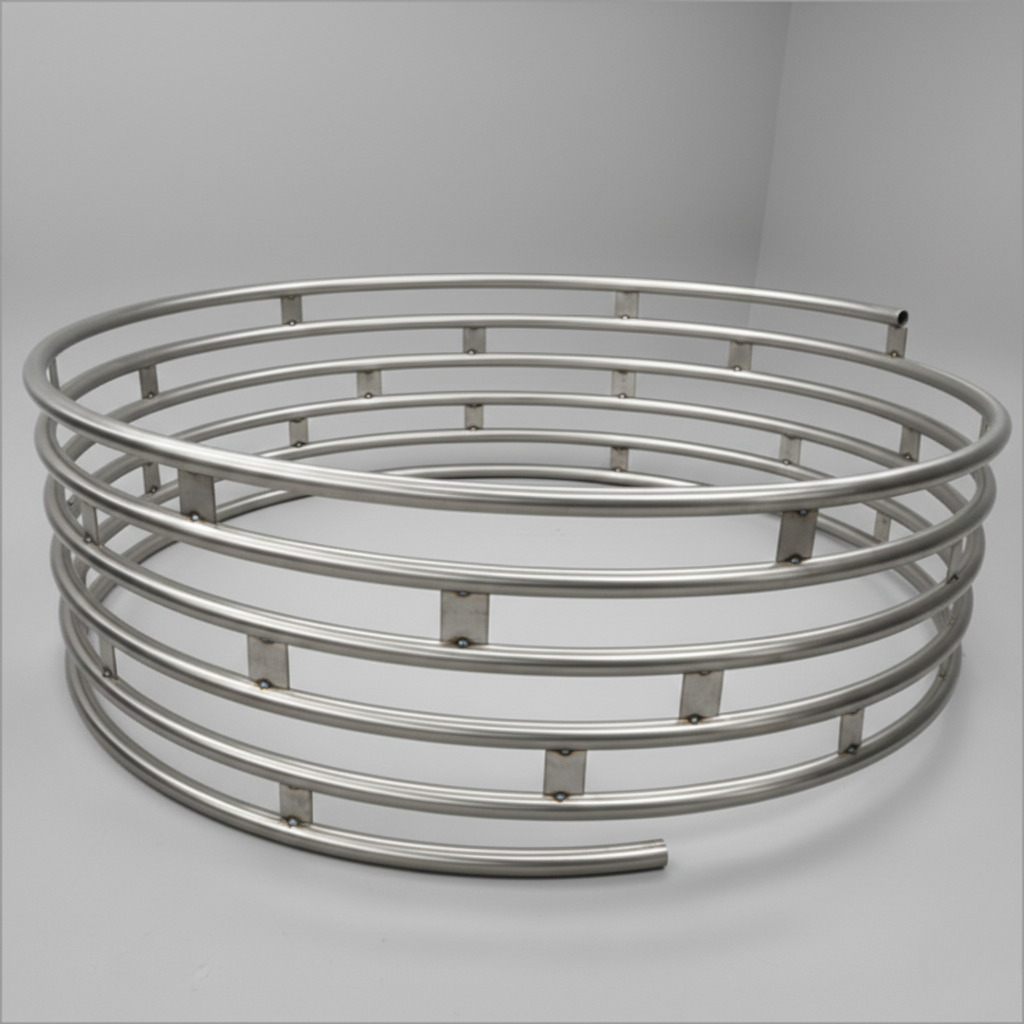
Technical Specification
| Product Type | Stainless Steel (SS) Cooling Coil |
|---|---|
| Construction | High-Quality SS 304 / SS 316 Tubes with Robust Support Frame |
| Coil Type | Helical / Spiral / Straight Pipe Coils (Customizable) |
| Flow Capacity | Customizable (as per LPH / m³/hr / Process Requirement) |
| Design Standard | As per Client Requirement / IS / ASME / Industry Standards |
| Material Grade | SS 304 / SS 316 (Corrosion & Chemical Resistant) |
| Operating Temperature | Ambient to High-Temperature Liquids & Gases |
| Surface Finish | Polished / Passivated / Food-Grade Finish (as required) |
| Applications | Chemical, Pharmaceutical, Food & Beverage, Water Treatment, and Process Industries |


Contact Anshika Engineering Now
Features
SS Cooling Coil
Heavy-Duty Mild Steel Construction
Pressure Optimization
Vertical / Horizontal Orientation
Safety & Compliance
WHY CHOOSE
Frequently Asked
Question
What is an SS cooling coil used for?
SS Cooling Coils are used to lower the temperature of liquids or gases in industrial processes, ensuring consistent and efficient heat exchange for chemical, pharmaceutical, food, and water treatment applications.
What materials are used in SS cooling coil construction?
Cooling coils are made of high-quality stainless steel, typically SS 304 or SS 316, offering corrosion resistance, durability, and hygienic performance.
Can SS cooling coils be customized for specific processes?
Yes, SS cooling coils can be customized in terms of coil type (helical, spiral, straight), tube diameter, length, and flow capacity to match precise process requirements.
How is maintenance handled for SS cooling coils?
These coils are designed for easy cleaning and minimal maintenance, ensuring long-term reliable performance in industrial operations.
What industries commonly use SS cooling coils?
SS Cooling Coils are widely used in chemical, pharmaceutical, food & beverage, water treatment, and other industrial applications where efficient and hygienic heat exchange is critical.